
Our blogs
Helpful tips, news, blogs and stories. Happy reading!
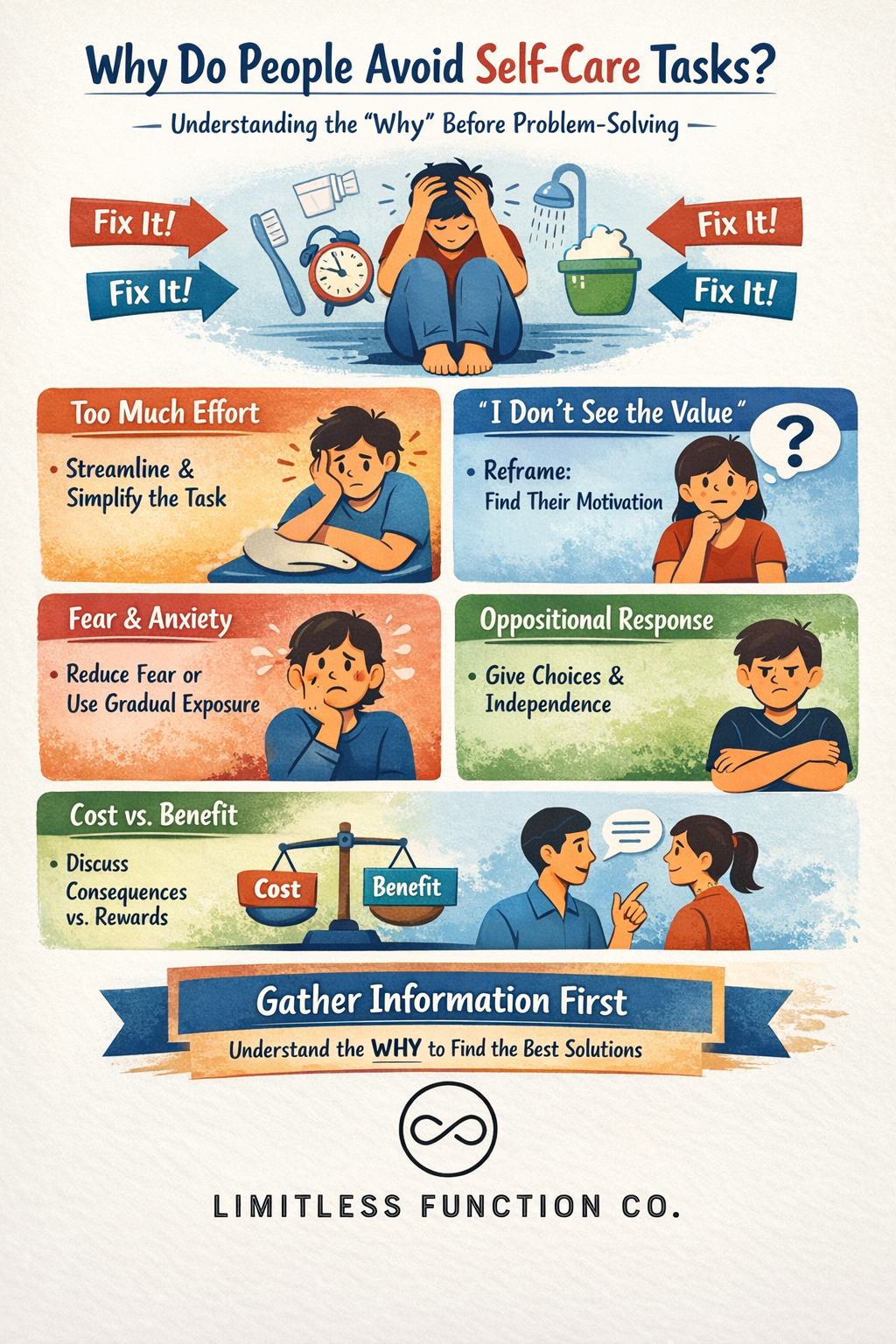
Why Do People Avoid Self-Care Tasks?
Moving Beyond “Just Do It” — Understanding the Why First
Self-care tasks — showering, brushing teeth, getting dressed, managing hygiene, eating well — are often seen as “basic” daily activities. Because of this, when someone avoids them, the default response from others is usually frustration… followed quickly by problem-solving mode.
“Let’s make a routine.”
“Set reminders.”
“Create consequences.”
“They just need more discipline.”
While these strategies can sometimes help, they often miss the most important first step:
Thorough Information Gathering
Before jumping to solutions, we need to understand why the person is avoiding the task.
Avoidance is rarely about laziness or defiance. It is usually a signal that something about the activity feels:
Too hard
Too overwhelming
Pointless
Anxiety-provoking
Demanding of energy they don’t have
When we take time to understand the driver behind the avoidance, the pathway forward becomes clearer — and far more effective.
Below are some of the most common reasons we see for self-care avoidance, and practical ways to respond.
1. “It’s Too Much Effort”
For many people, self-care tasks feel mentally and physically exhausting.
This is especially true for individuals experiencing:
Executive functioning challenges
Depression or low motivation
Chronic fatigue or burnout
Neurodivergence (e.g., ADHD, Autism)
The task may appear small to others — but internally, it feels like climbing a mountain.
What Helps
Streamline the activity. Reduce the effort required.
Practical ideas:
Lay clothes out the night before
Use 2-in-1 shampoo/body wash
Keep hygiene items visible and accessible
Sit while showering if fatigue is high
Use electric toothbrushes to reduce effort
Break tasks into micro-steps
Example:
Instead of “Have a shower,” try:
Turn the water on
Step in
Rinse body
Wash hair (optional today)
Lowering the activation energy makes starting easier — and starting is often the hardest part.
2. “I Don’t See the Value”
Sometimes the person genuinely does not value the task — at least not in the way others expect.
For example:
“I don’t care what I look like.”
“It doesn’t matter if I skip one day.”
“No one sees me anyway.”
Rather than arguing, we explore their personal values.
Because often, the value does exist — just in a different form.
Reframing the Value
We link the task to something that matters to them.
Examples:
They may not care about appearance — but care about others’ perceptions
They may value relationships — and hygiene impacts social comfort
They may value independence — and self-care supports this
They may value work — and presentation affects employability
It becomes less about:
“You should care about hygiene.”
And more about:
“How does this connect to what matters to you?”
When self-care aligns with personal values, motivation becomes intrinsic — not forced.
3. Fear or Anxiety Around the Task
Avoidance is often fear-based.
This can include:
Sensory discomfort (water pressure, smells, textures)
Body image concerns
Trauma associations
Fear of slipping/falling
Fear of doing the task “wrong”
If fear is present, pushing harder usually increases resistance.
Two Key Pathways
1. Reduce or eliminate the overwhelming element
Examples:
Adjust water temperature/pressure
Change lighting in the bathroom
Use unscented products
Install grab rails or shower chairs
Play music to regulate sensory input
2. Use graded exposure
Gradually build tolerance and comfort:
Step examples:
Sit in the bathroom
Turn the shower on without entering
Step in for 30 seconds
Full shower with support
Slow, supported exposure builds regulation and confidence over time.
4. Oppositional Responses (“Stop Nagging Me”)
Sometimes avoidance is not about the task itself — but the dynamic around it.
If a person feels:
Controlled
Micromanaged
Constantly reminded
Criticised
They may become oppositional — even if they understand the task is important.
This is especially common in adolescents and young adults, but can occur at any age.
What Helps
Shift from demands → collaboration.
Practical strategies:
Offer choices
“Morning or evening shower?”
Allow autonomy in timing
“What time works for you today?”
Maintain boundaries without force
“It does need to happen today — you choose when.”
This preserves dignity and control while still supporting completion.
5. Building Trust & Follow-Through
Nagging often increases when follow-through is inconsistent.
We reframe this conversation around trust:
If they follow through on agreed tasks → reminders reduce
If they don’t → prompts increase
This creates a natural accountability loop rather than a power struggle.
6. Understanding the Cost vs Benefit
Many individuals only see the effort of doing the task — not the cost of avoiding it.
We make this visible.
Cost of Avoidance
Time spent arguing or in conflict
Feeling guilty or ashamed
Social discomfort
Negative perceptions from others
Reduced opportunities (work, relationships)
Benefits of Completion
Tasks often take less time than the fallout of avoidance
Reduced conflict at home
Increased independence
More positive social interactions
Greater self-confidence
A helpful reflection question:
“Did avoiding the task actually save you energy — or cost you more?”
Key Takeaways for Families & Supports
When supporting someone with self-care avoidance:
Do:
Get curious before giving solutions
Ask open questions
Explore effort, value, fear, and control dynamics
Collaborate on strategies
Break tasks down
Link tasks to personal values
Avoid:
Assuming laziness
Jumping straight to routines or consequences
Nagging without understanding barriers
Power struggles
Final Thoughts
Self-care avoidance is not a character flaw — it is communication.
When we slow down and understand the “why,” we move from:
❌ Forcing compliance
→ ✅ Building sustainable engagement
Because once the barrier is understood, the intervention becomes clearer, more compassionate, and far more effective.
Slide sheets, an oh so helpful and cost-effective aid which can achieve so much in an instant!

With the right knowledge, patients and carers can achieve so much with slide sheets. Slide sheets can be used to easily position a sling behind a wheelchair users back, when it initially appears a near impossible task.
Slide sheets are also a great option when completing a slide transfer with a heavy patient. Using two slide sheets instead of one creates two friction free surfaces, for ultimate sliding across a surface. When carers engage these patients in a slide transfer, for example from bed to shower trolley, patients will seamlessly float from one to the other. This is all achieved with slide sheets. Suddenly carers of all shapes and sizes who thought they could not transfer a patient due to manual handling difficulties, have newfound confidence. This is all achieved with the right knowledge. Our Occupational Therapists have expertise in this area. This might be a simple and quick fix to one of your patients difficulties, instead of engaging in lengthy equipment trials, reports and approval waiting periods.
See the following video for a great example of how a slide sheet can be used with other assistive technology aids:
Grabrails, why is it so important to get it right?


Grabrails may seem very basic. However, the positioning of a grabrail is pivotal for the safety and independence of a user when completing a sit-to-stand transfer. It you refer to the diagram to the right, most without clinical expertise will think phases 2 & 3 are the most dangerous parts of a transfer. However phase 4 is the most dangerous part. The hazardous part of this phase is due to an immediate need to counter balance to stop the forward momentum (which can be difficult for someone to do when balance, proprioception and vestibular capacities are impaired). The second reason why this phase is the most dangerous: is the fact the force of a fall from a standing position will cause more harm/injury of significance than a fall from a lower/near seated position.
Therefore the most important portion of a grabrail is the section in front of the seat surface, as this provides the user with support when needing to counter balance as well as providing support during all phases of the transfer. The height of this portion of a grabrail is also very important as this will allow the user to establish stability and balance once they have reached a standing position.
Sensory avoiding? What is it? How to manage it?

Sensory avoiding represents a low neurological threshold for a particular type of sensory input. Sensory avoiding often looks like a child or adult who tries to keep new sensory stimuli away or an individual who retreats from unfamiliar situations. This is referred to as someone who is an 'avoider'.
Individuals with this sensory processing pattern will benefit from the following strategies:
Creating structure around the unfamiliar activity. Structure provides predictable sensory experiences. Predictability usually reduces anxiety and improves participation.
These individuals are better able to participate in everyday life when overwhelming sensory input is reduced or even in some cases eliminated.
If having to deal with a challenging and/or overwhelming environment, it is important these individuals have the opportunity to take frequent breaks (rather than avoid the task completely). Consistently incorporating breaks into difficult activities builds structure and routine. Breaks also provide a clear end point to the difficult task.
Engaging in a difficult task in small doses, makes the task seem more achievable/doable and therefore promotes improved participation.